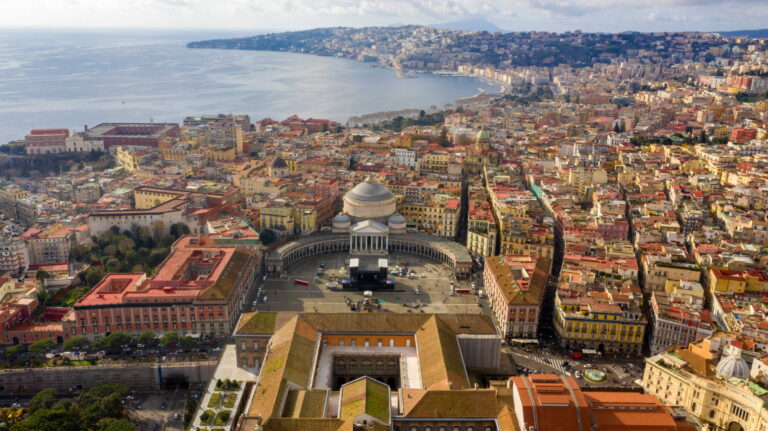
Naples is a city that has always had a visceral relationship with water: the water of the gulf that embraces it, the mythical water of the River Sebeto, said by legend to once flow beneath its streets, and the water channelled over the centuries through aqueducts that survived different eras and rulers. Walking through the alleys of the historic centre, it’s common to come across a monumental fountain without quite knowing what you’re looking at: a Baroque sculpture, a symbol of power, a story carved in stone. Those who walk through Naples with a trained eye, however, recognise in every fountain a different chapter of the city’s history. Here is a guide to help you start reading them properly.
A story two thousand years in the making
Long before they became ornaments, Naples’ fountains were vital infrastructure. Over the centuries the city drew its water from different sources: the legendary waters of the Sebeto, the Roman aqueduct of Serino, and later the historic Bolla aqueduct and the Carmignano canal, which for a long time guaranteed the water supply of the Neapolitan capital. It was only in 1885, in the presence of the King of Italy, that the monumental fountain in Piazza del Plebiscito was inaugurated, built to celebrate the new aqueduct that, reviving the ancient Roman tradition, brought the spring waters of the Serino plateau, in the province of Avellino, back into the city. Understanding this hydraulic history helps you look at Naples’ fountains with new eyes: not simply decorative features, but monuments that tell the story of how the city survived, grew, and told its own story through water.

Fontana del Nettuno: the queen of Piazza Municipio
Among the most famous and photographed fountains in Naples is undoubtedly the Fontana del Nettuno (Fountain of Neptune), now located in Piazza Municipio, directly opposite the Maschio Angioino castle. Its history, however, is anything but straightforward: over the centuries it has been moved several times to different parts of the city before finding its current location. The statue of the sea god that dominates it was created in 1600 by Michelangelo Naccherino, one of the most important sculptors active in Naples between the 16th and 17th centuries. Each of the fountain’s relocations, in fact, tells a piece of urban history: squares that changed function, palaces built or demolished, a power that asserted itself even through the city’s public spaces.

Fontana del Gigante: the giant rediscovered at Cuma
Less known to hurried tourists but no less fascinating is the Fontana del Gigante (Fountain of the Giant), on the corner of Via Nazario Sauro and Via Partenope. It was commissioned by the viceroy in the early 17th century and originally placed perpendicular to the façade of the new Royal Palace, built in those years by Domenico Fontana, as a scenic feature marking the edge of the square towards the sea. Michelangelo Naccherino and Pietro Bernini both worked on it, and the fountain took its current name after it was flanked by an enormous statue of Jupiter, discovered years earlier during the archaeological excavations at Cuma. A detail that says a great deal about how Naples has always recycled and reinterpreted its Greek-Roman past, setting it into its Baroque urban fabric.

Fontana del Sebeto: mythology carved in stone
If there is one fountain that tells the story of the bond between Naples and its legendary river, it is the Fontana del Sebeto, designed by Cosimo Fanzago, one of the leading figures of Neapolitan Baroque, commissioned by Viceroy Emanuele Zúñiga y Fonseca. On either side of the fountain stand four lions from which water flows, each decorated with the city’s coat of arms and that of the commissioning duke. Pietro Bernini created the sea monsters that pour water into the central basin, decorated with dolphins and tritons, while at the centre Neptune — another work by Naccherino, the sculptor behind the fountain in Piazza Municipio — rises from a rock supported by two nymphs and two satyrs. A true mythological stage set, designed to amaze anyone who came across it while strolling along the seafront.

The lesser-known fountains not to miss
Beyond the major monuments, the historic centre hides more discreet but no less interesting fountains. The Fontana di Monteoliveto, in the square of the same name, is also known as the Fontana di Re Carlo for the bronze statue of Charles II of Spain that stands above it. The Fontana della Spina Corona, built in the 16th century and restored during the Bourbon era, is said to take its name from a nearby convent that once held a relic of Christ’s Crown of Thorns — a small Renaissance jewel hidden in the ancient heart of the city. Further from the centre, towards Capodimonte, the Fontana della Duchessa was commissioned by Maria Carolina of Austria, wife of Ferdinand IV, and takes its name from the Duchess of San Nicandro, who oversaw its design: in white marble and bronze, decorated with floral motifs, it represents the refinement of Neapolitan art between the 17th and 19th centuries.
A detail for true connoisseurs
In recent years, Naples City Council, together with several local clubs, has installed small information totems at the city’s historic fountains, bearing plaques with the year of construction, the artist’s name, and a QR code linking to further details on the fountain’s history via smartphone. The texts on these panels draw on dedicated studies of Naples’ fountains and offer a level of detail rarely found in general guidebooks. For those who like to travel with the curiosity of someone who genuinely wants to understand what they’re looking at, this is a small but valuable resource — one best paired with the insight of someone who truly knows the city, able to connect the dots between one fountain and the next with anecdotes no QR code could ever contain.
Discover Naples with us
The fountains of Naples are quiet yet eloquent chapters in a much larger story, made of viceroys, brilliant sculptors, legends, and water that has been flowing for two thousand years. Walking between Piazza Municipio, Via Nazario Sauro, and the alleys of Monteoliveto with a guide who knows where to look turns a simple stroll into a genuine journey through time. With OtherWise Travel's walking tours, you can discover these and many other hidden stories in the historic centre of Naples, one step at a time. Discover Naples with us.